Let us get one thing straight before we begin: there is no single best country for MBBS abroad. Anyone who says otherwise is usually oversimplifying the decision or trying to push a fixed destination.
What actually exists is a shortlist of countries that each do certain things well. The right choice depends on your NEET score, your budget, how much uncertainty your family can tolerate, and what you want to do after your degree.
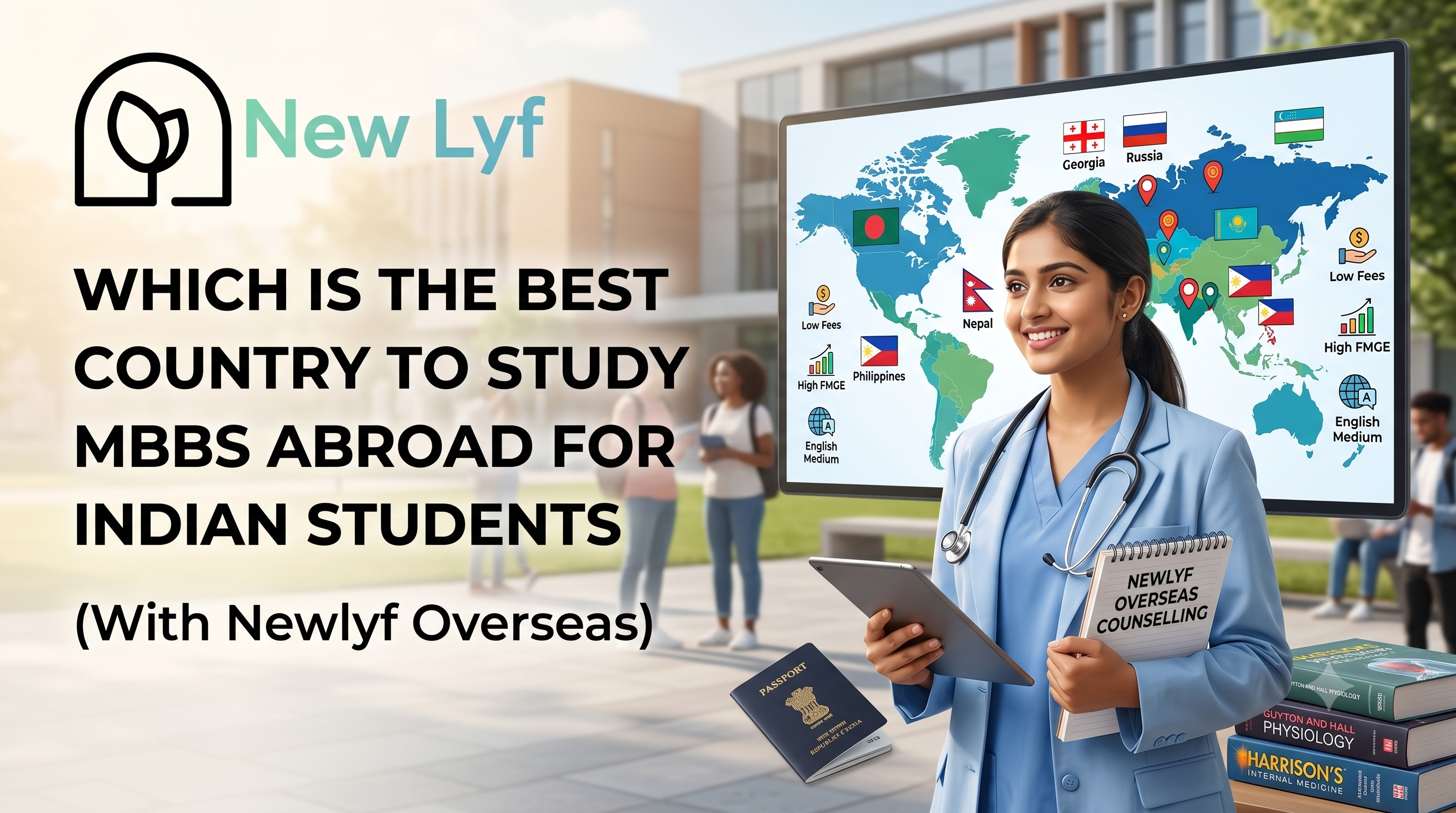
Bangladesh, Nepal, the Philippines, Georgia, Russia, and a few Central Asian countries come up repeatedly when Indian families start comparing options. This guide explains where each one stands, what the NMC rules actually demand, and how Newlyf Overseas helps students avoid expensive mistakes.
Best Country Is the Wrong Question to Start With
Most families begin by asking which country is the best. That sounds logical, but it usually leads to the wrong conversation.
A better question is this: which country fits your budget, matches your risk appetite, gives you the clinical exposure you will realistically need, and still leaves you with a workable Plan B if FMGE or NExT does not go as expected?
Every destination has a different strength. Some are more affordable. Some produce stronger FMGE outcomes. Some give you a fully English-speaking environment. Some keep future options open outside India. None is perfect for everyone.
That is why Newlyf Overseas does not begin with a country pitch. We begin with profile fit.
NMC Rules: What You Need to Know Before Choosing Any Country
This is the part most agents rush through, even though it is the part that matters most years later.
Under the Foreign Medical Graduate Licentiate Regulations, the NMC has laid down very clear conditions for Indian students who study medicine abroad and later want to register in India.
In simple terms, the degree has to satisfy these requirements:
- At least 54 months of academic study at the same institution.
- A 12-month internship completed at that same foreign institution.
- The full programme, including classes, practicals, and clinical training, must be taught in English.
- The degree must be legally recognised in that country and must make the graduate eligible for a local licence on the same terms as local students.
- The student must have qualified NEET-UG before starting MBBS abroad if the long-term plan includes medical registration in India.
Students whose courses were disrupted by war, hybrid classes, or online pandemic-era adjustments need to be especially careful. NMC has already clarified that in-person clinical training and proper course structure are not optional.
Newlyf Overseas screens universities against these rules before recommending them because compliance failures usually surface too late to repair.
What the FMGE Numbers Actually Show
FMGE data never tells the whole story, but it still tells an important part of it.
In June 2025, Bangladesh recorded a 31.52 percent pass rate, Georgia 27.68 percent, Nepal 22.54 percent, and the Philippines 18.99 percent. Russia, China, Kyrgyzstan, Kazakhstan, and Uzbekistan came in lower in many cycles.
But pass rate alone is not enough. Families also need to ask:
- Is the curriculum aligned to Indian licensing exams?
- Is the clinical language actually usable for international students?
- Are students getting real hands-on exposure or just attending wards passively?
At Newlyf Overseas, we treat FMGE and future NExT relevance as one factor, not the only factor.
Bangladesh and Nepal: Closest to Home, Most Relevant to India
If the main goal is to come back and practise in India, Bangladesh and Nepal deserve serious attention.
These countries often feel closer to the Indian medical environment than other foreign options. Students work with familiar disease patterns, familiar treatment logic, and a curriculum structure that usually feels more natural to Indian learners. Language and food are also much easier to adjust to.
This matters more than it sounds on paper. Students who understand patients, local teaching methods, and everyday life from the beginning usually adapt faster and retain more.
That is one reason Bangladesh and Nepal often remain strong choices for families whose priority is India-return practicality rather than international branding.
Newlyf Overseas usually keeps both countries high on the shortlist for students looking for a lower-risk academic adjustment curve.
Philippines and Georgia: Better if You Are Thinking Beyond India Too
Some students want to preserve international options in addition to India.
For that profile, the Philippines and Georgia are worth considering because both countries offer English-medium teaching and are often chosen by students who may later consider USMLE or PLAB-style pathways.
The Philippines has long appealed to Indian students because of its English-speaking environment and structured teaching style. Georgia has gained attention more recently because some universities there have shown relatively stronger FMGE outcomes while still keeping costs lower than private MBBS in India.
That said, both destinations still need university-level verification. An English-speaking country alone does not guarantee NMC compliance. The exact internship model, degree structure, and host-country licensing position still matter.
Newlyf Overseas helps families distinguish between country-level reputation and university-level reality.
Russia and Central Asia: Attractive Fees, but Not Without Trade-Offs
Russia, Kyrgyzstan, Kazakhstan, and Uzbekistan keep attracting Indian students for a simple reason: the fee structures are often far more affordable than Indian private colleges.
That affordability makes them genuinely relevant, especially for families trying to stay under a defined budget. But low tuition is not the same as low risk.
In many Central Asian destinations, clinical teaching frequently shifts into local languages. That can reduce the student’s ability to participate confidently in patient-facing work. Russia has older, better-established universities, but Russian language competence still matters heavily once clinical years begin.
There is also the wider geopolitical factor. Since 2022, Russia-related banking, remittance, and sanction-linked complications have made financial planning more sensitive for Indian families.
Newlyf Overseas does not rule these destinations out. We simply make sure students understand what affordability is buying and what it is not buying.
The Foreign Internship: What Mandatory Actually Means
Many families read the NMC rule about internship and assume it is a routine formality. It is not.
The required 12-month internship has to be a genuine, supervised, hands-on clinical year at the same foreign institution. In some countries, foreign students are restricted in how actively they can work with patients. That creates a mismatch between paper completion and real clinical readiness.
This is one reason we ask not only whether the internship exists, but what students actually do during it.
Where practical exposure appears weak, Newlyf Overseas often advises students to use vacations strategically for observerships or additional clinical familiarity in India, without confusing that with formal internship substitution.
The Geopolitics Problem: Do Not Ignore It
The Russia-Ukraine disruption exposed a problem many families had never considered seriously. Students can be affected not only by academics and visas, but by sudden changes in war, diplomacy, remittance channels, and cross-border movement.
Some of these issues have been partially managed through new payment channels and alternative banking routes. But partially managed is not the same as fully stable.
Families investing five to seven years and tens of lakhs need to ask a hard question: if the situation changes suddenly, can we handle the disruption?
Where a family has very low tolerance for uncertainty, Newlyf Overseas usually recommends more stable jurisdictions. Where the family still wants a high-value but higher-risk route, we explain the trade-off openly.
Mental Health and Safety: The Things Families Often Ask Too Late
Academic quality matters, but so do adjustment, safety, and emotional resilience.
Studying medicine abroad can be isolating. Language barriers, unfamiliar food, winter climates, and the intensity of the course all affect how students cope, especially in the first year.
Before finalising a destination, families should ask:
- Is there an Indian student community that is genuinely supportive?
- What do current female students say about daily safety?
- Is there access to counselling or at least English-speaking support if the student struggles?
- What is the city like outside the university brochure?
Newlyf Overseas treats this as standard counselling, not an optional extra.
About USMLE and PLAB: Honest Expectations Matter
USMLE and PLAB are often used as sales hooks. But being eligible for a pathway and actually being competitive in that pathway are two different things.
USMLE demands early planning, multiple exam stages, extra spending, and a realistic understanding of how competitive residency matches are for international graduates. PLAB is often more accessible, but still requires structured preparation, GMC registration, and later job search navigation.
None of that makes these routes unrealistic. It just means they should be planned deliberately, not mentioned casually in a brochure.
For students who are serious about those international routes, Newlyf Overseas helps build the university selection and exam timeline from much earlier in the journey.
What Happens If FMGE or NExT Does Not Work Out?
This is the question many people avoid, but it is one of the most important ones to ask.
Foreign medical graduates in India have always faced uneven licensing outcomes. That means families should not invest six years assuming only one future exists.
The good news is that the degree can still open structured alternatives, such as:
- Hospital administration and healthcare management
- Public health and MPH pathways
- Clinical research and pharmacovigilance
- Medical coding and medical writing
- Health-tech and healthcare operations roles
These are not fallback afterthoughts. They are real career avenues, but students navigate them better when the conversation begins early instead of after repeated exam setbacks.
Newlyf Overseas brings these realities into counselling upfront so students are mentally prepared for multiple outcomes, not trapped by a single rigid expectation.
The Practical Checklist Before You Decide
A strong decision about MBBS abroad should follow a sequence:
- Confirm your NEET result and understand which NMC rules apply to your batch.
- Narrow countries based on true total cost, not just first-year tuition.
- Verify WDOMS listing and full NMC compliance for every shortlisted university.
- Speak to real seniors or current students, not just marketing testimonials.
- Budget for documentation, apostille, insurance, travel, and exam preparation after admission.
This is exactly where Newlyf Overseas fits in. We help students compare countries, check regulatory safety, organise applications, manage documentation, plan finances, and stay aligned with future licensing goals.
FAQs: What Newlyf Overseas Can Actually Do for You
Can Newlyf Overseas help me choose a country based on my NEET score and budget?
Yes. We assess your NEET score, budget, academic profile, and long-term goals, then shortlist destinations and universities that fit both NMC rules and practical return outcomes.
How do you make sure a university is NMC-compliant?
We verify course structure, internship format, English-medium teaching, local licensing eligibility, WDOMS status, and public NMC advisories before recommending a university.
Do you help with documentation, apostilles, and visas?
Yes. That includes applications, translations, notarisation, MEA apostille, visa file support, travel logistics, and early settlement guidance based on the destination country.
What about FMGE or NExT preparation while I am studying abroad?
We guide students on when to start structured licensing preparation, recommend credible support systems, and help them use vacations strategically so their foreign education stays relevant to Indian exam expectations.
What if I cannot clear FMGE or NExT after multiple attempts?
We counsel students on structured alternatives including MHA, MPH, clinical research, pharmacovigilance, medical coding, medical writing, and health-tech pathways, so they still have direction and clarity.
Final Word
Choosing where to study MBBS abroad is one of the biggest academic and financial decisions an Indian family will make. There is no universal best country. There are only countries that fit well, countries that fit poorly, and countries that need much deeper checking before money is committed.
Newlyf Overseas exists to make sure that choice is driven by facts, regulations, and realistic planning rather than hype. The right destination is the one that still makes sense after cost, safety, licensing, language, and long-term career questions are all answered honestly.