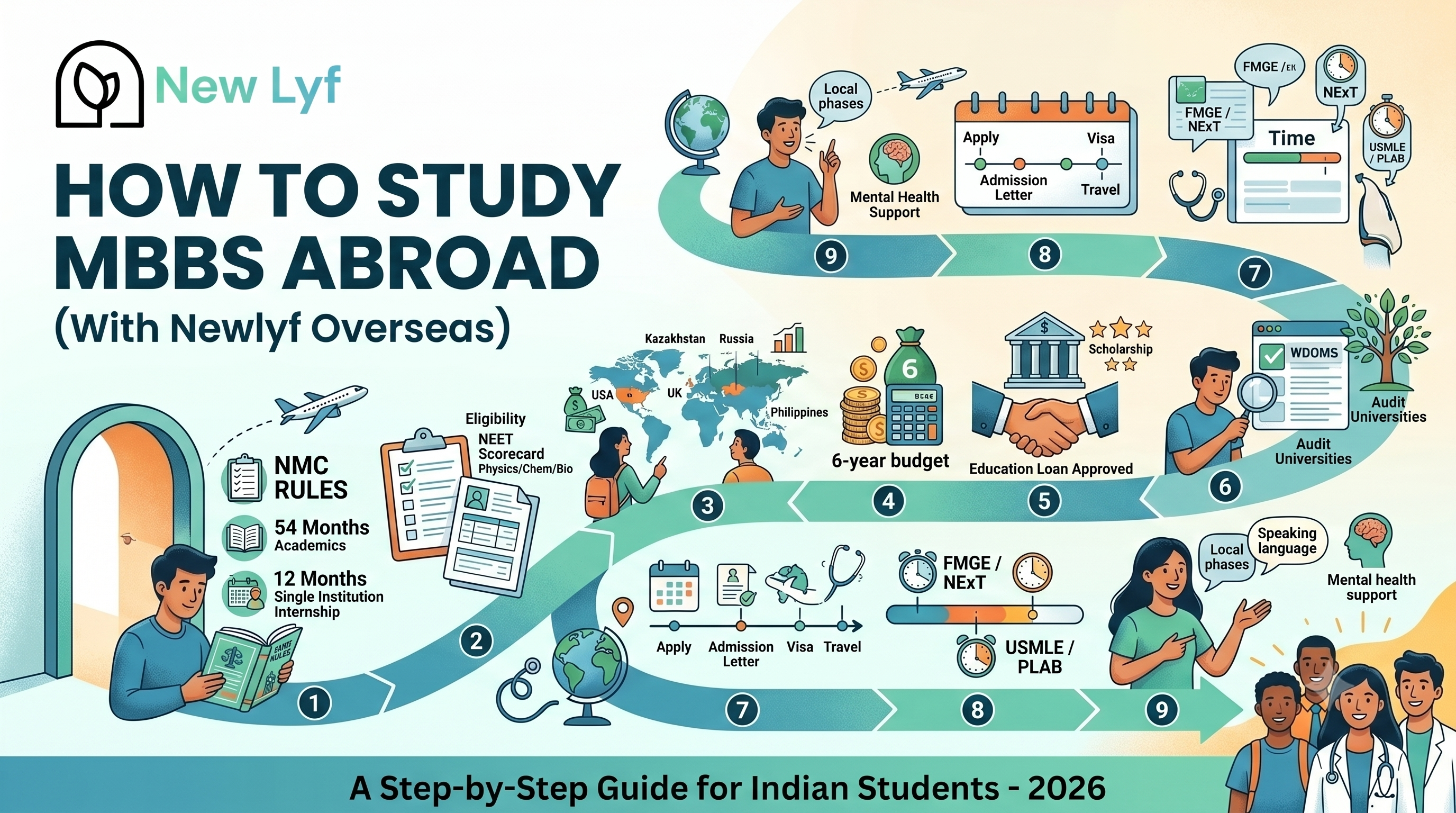
Studying MBBS abroad is no longer just a backup option. For many Indian families, it has become a serious and high-stakes decision that involves NMC regulations, long-term budgets, licensing exams, and a chain of practical choices that most students do not fully understand when they begin.
This guide explains how to study MBBS abroad in 2026 step by step and shows where Newlyf Overseas helps families move from confusion to a structured plan.
It Is a Strategy, Not a Last Resort
Government MBBS seats in India remain severely limited, while private medical college fees have crossed Rs 80-Rs 90 lakh at many institutions. That is why thousands of students look abroad after NEET every year.
But admission alone does not solve the bigger problem. A foreign MBBS seat is useful only if the degree satisfies NMC norms and still leads to a practical licensing path through FMGE, NExT, USMLE, PLAB, or another route. That gap between getting admitted and securing a real career is exactly where families need proper guidance.
Step 1 - Get the NMC Rules Into Your Head First
The 54-Month and 12-Month Internship Rules
Everything starts here. Under the NMC FMGL Regulations 2021, your foreign MBBS must include at least 54 months of academic training plus a full 12-month internship. In practical terms, that means the overall programme has to cover a full six-year structure.
If a university markets a four-year fast-track MD or a five-year course with no proper internship year, that is a serious red flag for Indian students.
Single Institution, English Medium - Both Are Non-Negotiable
All 54 months of academics and the internship must happen at the same university in the same country. Split programmes, partner-campus models, or internship substitutions can create India-registration problems later.
NMC also expects the course, exams, and clinical exposure to be in English. A brochure may say English medium, but if the real clinical teaching happens in Russian, Georgian, or another local language, the compliance position becomes weaker.
NEET Is Still Mandatory
If you plan to return and practise in India, NEET qualification is not optional. It is a legal requirement. NMC has also tightened its view on disrupted or online-heavy training, so hands-on clinical exposure matters more than ever.
Newlyf Overseas screens universities against these rules before recommending them so that students do not discover a compliance problem only at the licensing stage.
Step 2 - Check Your Own Eligibility First
The basic rule is straightforward: you need 10+2 with Physics, Chemistry, and Biology, at least 50 percent aggregate marks in PCB for the general category, 40 percent for certain reserved categories, and you must be at least 17 years old by December 31 of the admission year.
In reality, any Indian student planning to come back and practise should treat NEET qualification as a strict baseline, even if a foreign university says it does not need NEET for admission.
Some destinations add extra filters. German public universities may require B2 or C1-level German and often a preparatory year. Some Western routes expect IELTS, TOEFL, or entrance tests. These are not small details. They change the route completely.
Newlyf Overseas maps your marks, NEET score, and language profile to practical destinations instead of handing over a generic list of countries.
Step 3 - Shortlist Countries by Budget, Lifestyle, and End Goal
Budget-Friendly Routes: Central Asia and Similar Regions
Countries such as Kazakhstan, Kyrgyzstan, and Uzbekistan are attractive because the total six-year cost can often stay in the Rs 12-Rs 25 lakh range. That matters to families with strict budgets.
But the trade-off is real. Hospital quality varies, local language becomes important, and students often need to compensate through stronger self-study. These countries work better for self-driven students who understand what they are signing up for.
Mid-Range Routes: Russia, Georgia, and Similar Options
These destinations often fall in the Rs 20-Rs 35 lakh band. They offer better infrastructure, larger student ecosystems, and universities with longer international track records.
At the same time, adaptation can be harder. Students deal with colder climates, stronger local-language pressure, and in Russia especially, banking and remittance complications that have affected Indian families since 2022.
High-Cost Routes: USA, UK, Canada, and Australia
These destinations offer strong global medical education but usually need much stronger academic profiles, more competitive entrance pathways, and budgets that often run into crores. They are not standard low-cost MBBS-abroad options.
Newlyf Overseas uses a structured profiling process to match destination choice to actual budget, long-term licensing goals, and family comfort level.
Step 4 - Calculate the Real Six-Year Budget
Tuition and hostel fees are only the beginning. A real six-year budget also includes food, transport, study materials, visa renewals, document translation, notarisation, MEA apostille, insurance, return flights, and later licensing-exam preparation.
Families also underestimate forex risk. Over six years, rupee depreciation can noticeably change the actual rupee cost of an otherwise fixed foreign fee.
Then come post-degree costs like FMGE or NExT preparation, or for international routes, USMLE and PLAB-related spending. Those can add several lakhs more.
Newlyf Overseas helps families create a line-item financial projection instead of relying only on a first-year fee quote.
Step 5 - Sort Out Loans, Scholarships, and Funding Early
Indian Education Loans
Indian banks and NBFCs do fund MBBS abroad, but the process is documentation-heavy. Larger amounts often need collateral, co-borrower income proof, admission letters, fee structures, KYC papers, and a university-recognition check.
Scholarships and Low-Tuition Routes
Some German public universities have near-zero tuition, but they expect strong language readiness and independent living capability. Selected universities in countries like Russia or China offer partial or full scholarships, but those are competitive and come with conditions.
Newlyf Overseas matches students to realistic scholarship and education-loan options instead of vague promises about almost free medical education.
Step 6 - Audit Universities Like a Regulator, Not a Tourist
Before paying any amount, verify these five things:
- Does the programme satisfy the 54-month academic rule?
- Is the 12-month internship at the same institution?
- Is the full teaching and clinical process genuinely in English?
- Does the degree lead to local licence eligibility on par with local graduates?
- Is the university properly listed on WDOMS?
If the plan involves USMLE later, students should also check ECFMG sponsor-note implications.
FMGE pass-rate trends by country and by university also matter. Low pass rates combined with weak language support or poor clinical exposure are meaningful warning signs.
Newlyf Overseas combines regulatory verification, FMGE trend review, and feedback from actual students before recommending a shortlist.
Step 7 - Follow the Admission and Documentation Timeline
The Standard Flow
Most MBBS-abroad journeys follow a familiar order: shortlist, check eligibility, apply, receive an offer letter, pay an initial fee, get the invitation letter, file the visa, travel, and complete on-arrival registration.
For many September or October intakes, students should ideally begin serious planning six to nine months in advance.
Documents You Need
- 10th and 12th mark sheets and certificates
- NEET scorecard
- Valid passport
- Birth certificate
- Passport-size photographs
- Medical fitness certificate including HIV and Hepatitis status where required
- Bank statement or proof of funds
- Admission and invitation letters from the university
Newlyf Overseas manages this documentation chain end to end so that the same file works for both university and visa-side scrutiny.
Step 8 - Plan for Licensing Exams from Year One, Not Year Five
Coming Back to India
Foreign graduates returning to India need to clear FMGE or the eventual NExT route and then complete the required internship or registration steps before full licensure. That means licensing strategy matters as much as admission strategy.
Students who begin building Indian exam alignment by the middle years of MBBS usually perform better than those who leave everything to the final year.
UK and USA Pathways
For the UK, the standard route includes PLAB and English-language proof before entering GMC-linked pathways. For the USA, students need early USMLE planning, ECFMG documentation, and often some kind of clinically relevant exposure or observership strategy.
Newlyf Overseas helps students align electives, exam timing, and study direction to the licensing route they actually want.
Step 9 - Prepare for Language, Mental Health, and Culture
Language Matters More Than Most Students Expect
Even when the university teaches in English, the hospital environment may not. In Russia, Georgia, Kazakhstan, and similar places, patients and ward staff often communicate in the local language. Students who never become functional in that local language often stay stuck in observer mode.
That weakens clinical confidence and can hurt FMGE or NExT preparedness later.
The Mental Health Reality
Students leaving India at 17 or 18 face homesickness, climate shock, unfamiliar food, academic stress, and social isolation. Many struggle in the first year before they stabilise.
That is why support systems matter: active international student offices, good local safety, access to counselling, and a useful Indian student community all make a real difference.
Newlyf Overseas considers safety, climate, daily support, and student adjustment while recommending destinations, especially for first-time travellers and female students.
FAQs: How Newlyf Overseas Actually Helps
Can you help me decide whether MBBS abroad suits my NEET score and budget?
Yes. Newlyf Overseas runs a structured profiling session based on your NEET score, 12th marks, budget, and long-term goals, then recommends only realistic NMC-compliant options.
How do you check NMC compliance for a university?
We check course duration, internship structure, teaching medium, local licence eligibility, WDOMS listing, and other regulatory conditions against current NMC expectations.
Do you help with loans, visas, and documentation?
Yes. That includes guidance on education loans, admissions paperwork, apostille, visa filing, travel preparation, and settlement support based on the destination country.
What about FMGE or NExT and international exams like USMLE or PLAB?
We help students build an exam-preparation roadmap early in the degree so the chosen university path stays aligned with Indian or international licensing goals.
What if FMGE does not work out or I change direction later?
Students are also guided toward non-clinical but credible alternatives such as hospital administration, public health, clinical research, pharmacovigilance, medical coding, medical writing, and health-tech roles.
Final Word
If you want to understand how to study MBBS abroad the right way, the process is not just about finding a cheap university or getting an offer letter quickly. It is about making sure the degree is valid, the budget is sustainable, the lifestyle is manageable, and the licensing pathway still works when you come home or move elsewhere.
That is why MBBS abroad should be treated as a long-term strategy, not a rushed reaction after NEET.
Newlyf Overseas helps Indian families make that decision with facts, documentation support, regulatory checks, and realistic planning from the first counselling call to the final career pathway discussion.