Reviewed & updated: July 2026 · Written by Dr. John Bosco, Overseas Education Counsellor
MBBS Abroad for Indian Students:
The Complete 2026 Guide
Every year, more than 25,000 Indian students leave the country to study MBBS abroad — not because Indian medical education is inferior, but because there are roughly 1.18 lakh MBBS seats in India against over 22 lakh NEET-UG applicants. For most families, the real choice isn't "India or abroad" — it's between an unaffordable private seat at home and a globally recognised, NMC-compliant degree overseas at a fraction of the cost.
Quick Answer
MBBS abroad is a globally recognized medical degree program pursued by Indian students in NMC-compliant countries (like Georgia, Russia, and Central Asia) due to competitive seat limits and high private tuition fees in India. It typically costs ₹15–45 lakh all-inclusive and requires NEET qualification to practice in India post-graduation.
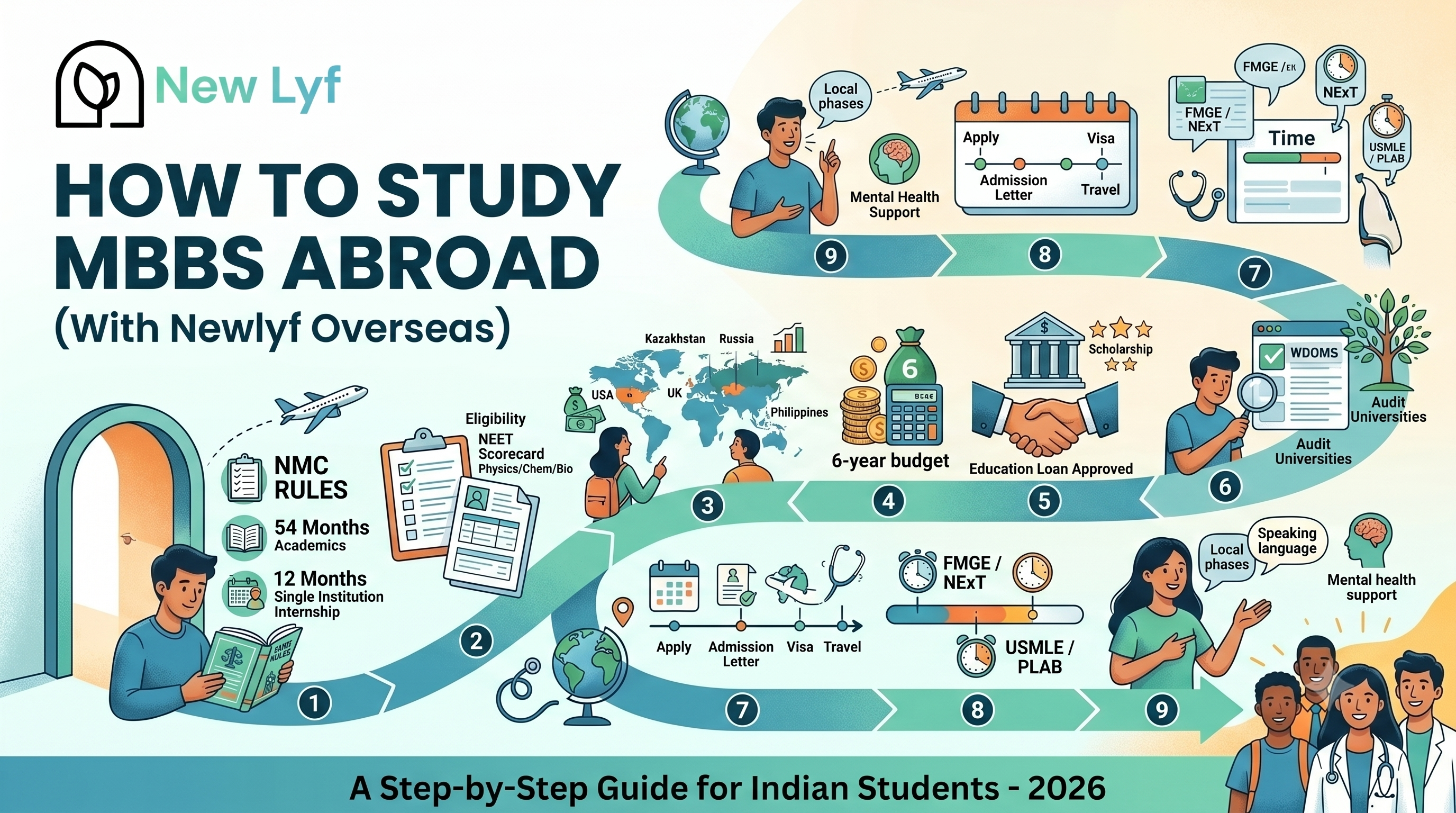
This guide covers everything you need before you commit: the 2026 NMC rules that decide whether your degree will even be valid in India, real fee comparisons across ten countries, eligibility, required documents, the admission process step-by-step, and the exam pathway (NEET → FMGE/NExT) you'll need after you graduate.
Why Indian Students Choose MBBS Abroad
The pressure at home is structural, not personal. Private medical colleges in India routinely charge ₹60 lakh–₹1.2 crore for a full MBBS programme, and government seats — while affordable — are won by a small fraction of NEET-UG candidates. Against that backdrop, MBBS abroad has become less of an alternative and more of a mainstream path for capable students who simply couldn't get a seat that fits their budget.
Affordability.
A complete MBBS abroad, including tuition, hostel, and living costs, often costs less than one year at a private Indian college.
No donation or capitation fees.
Admission abroad is merit- and document-based; the 'management quota' system simply doesn't exist there.
Globally recognised degrees.
Universities affiliated with WHO and listed in the WFME/FAIMER directories issue degrees that are portable — provided you follow NMC's compliance rules.
English-medium instruction and smaller batches.
Countries like Georgia, Russia, and the Philippines run English-medium MBBS specifically for international students, often with better faculty-to-student ratios than crowded Indian colleges.
Early, hands-on clinical exposure.
Many university hospitals abroad see high patient volumes, so students start ward postings and clinical practice earlier than in overcrowded Indian institutions.
MBBS Abroad vs. MBBS in India
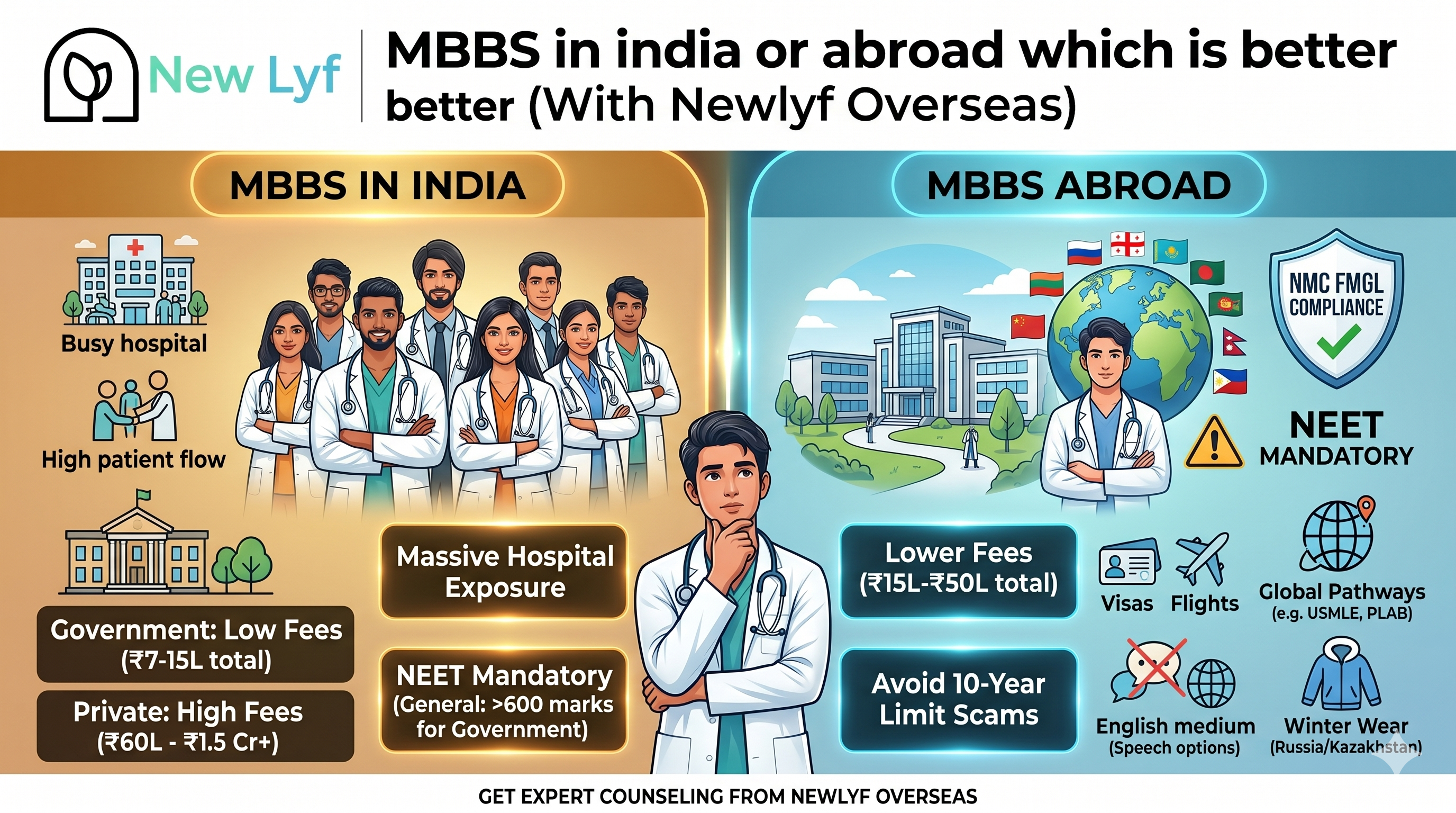
| Factor | MBBS in India (Private) | MBBS Abroad |
|---|---|---|
| Total course fee | ₹60 lakh – ₹1.2 crore | ₹15 lakh – ₹45 lakh (most NMC-compliant countries) |
| Admission basis | NEET-UG + management quota in many private colleges | NEET-UG qualification + direct university application (merit-based) |
| Donation/capitation fee | Common in many private colleges | Not applicable |
| Course duration | 5.5 years (incl. 1-year internship) | Minimum 5.5 years (54 months academic + 12-month internship, per NMC) |
| Medium of instruction | English | English (verify — not all universities are 100% English-medium) |
| License to practice in India | Direct after internship | Must clear FMGE / NExT after returning |
NMC Guidelines & FMGL Regulations 2021 for MBBS Abroad
This is the section most competing pages get wrong or leave out entirely — and it's the one that actually determines whether your degree means anything in India. Read it carefully before you shortlist a single university.
The 54-month + 12-month rule
Under the Foreign Medical Graduate Licentiate (FMGL) Regulations, 2021, issued by the National Medical Commission, any MBBS pursued abroad must consist of a minimum of 54 months (4.5 years) of academic study, followed by a compulsory 12-month clinical internship at the same institution where the academic programme was completed — for a total of roughly 5.5 years. Programmes shorter than this, or internships split across different institutions or countries, are not recognised in India, regardless of how reputable the university otherwise is.
English-medium instruction is mandatory
The entire course — lectures, practicals, clinical rotations, and examinations — must be conducted in English. Partial or bilingual programmes (common in some Central Asian and European universities) do not satisfy NMC's requirements. Always request the official curriculum document in English before paying any fee.
University recognition
NMC does not publish an \"approved list\" of foreign universities. Instead, it requires that the university be recognised in its home country and that graduates be eligible to practice medicine there. In practice, verify a university against the World Federation for Medical Education (WFME) directory and the FAIMER International Medical Education Directory — these are the same databases the National Board of Examinations uses to confirm eligibility when a foreign graduate registers for the licensing exam.
Eligibility Criteria for MBBS Abroad
To be eligible for MBBS abroad as an Indian student, in almost all NMC-compliant destinations, you need to:
- ✓Have completed 10+2 with Physics, Chemistry, and Biology, and English as a subject
- ✓Score at least 50% aggregate in PCB (general category; relaxed for reserved categories per NMC norms)
- ✓Be 17 years or older by December 31 of your admission year
- ✓Qualify NEET-UG — this is compulsory if you intend to practice in India later (see next section)
- ✓Hold a valid passport
Common Myth
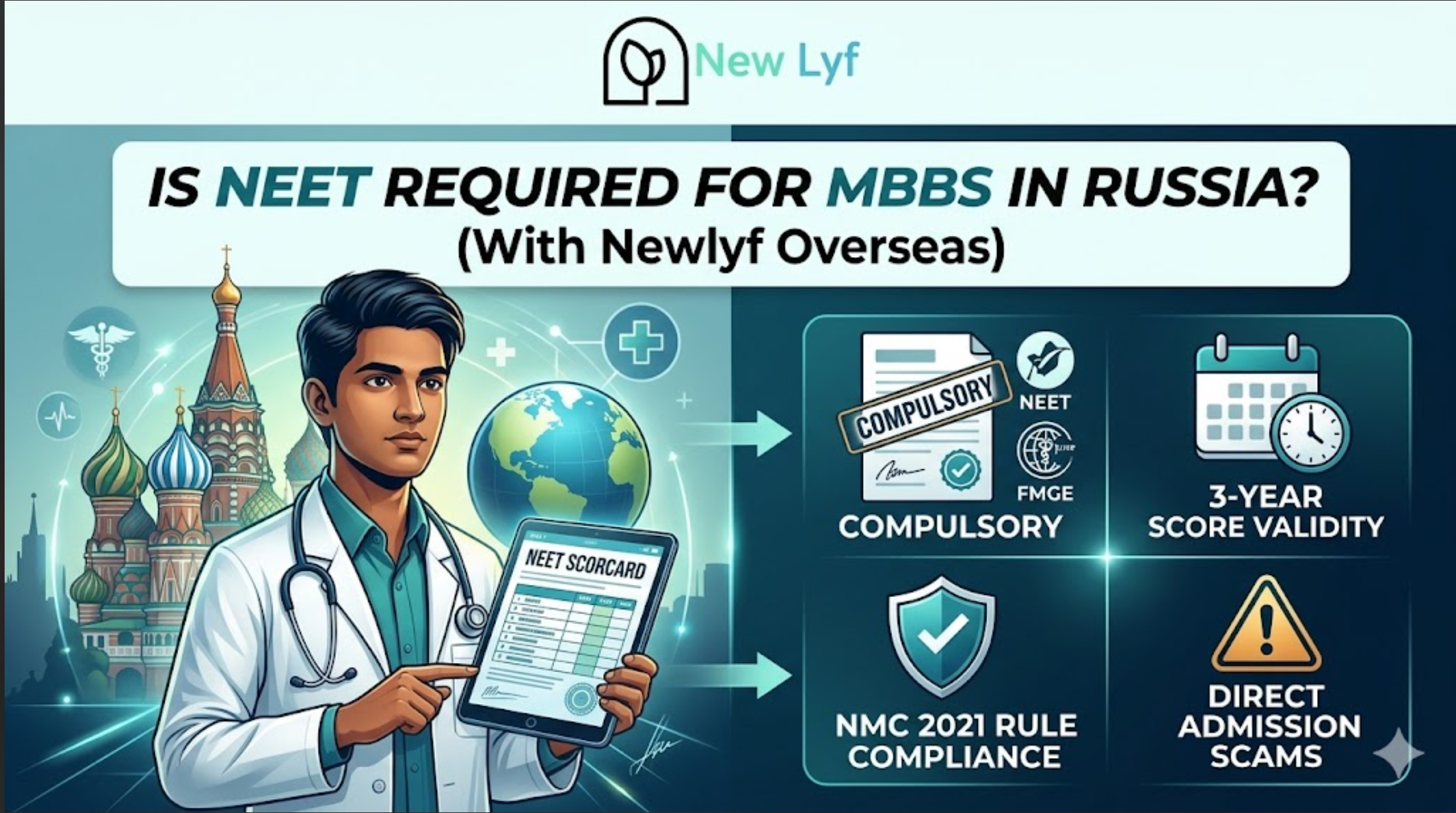
Is NEET Compulsory for MBBS Abroad?
Yes — and this is one of the most common myths agents use to oversell \"no-NEET\" admissions abroad. You can technically enrol in a foreign MBBS programme without a NEET-UG qualification, but without it you cannot register with the National Medical Commission or appear for the FMGE/NExT licensing exam, which means your degree cannot be used to practice medicine in India.
A NEET-UG scorecard is valid for 3 years for the purpose of admission abroad (longer than the 1-year validity used for Indian counselling), and there is no minimum qualifying cutoff required by foreign universities — you simply need to have appeared and qualified. Don't take an agent's word that NEET can be skipped; verify this directly against NMC's public notifications before enrolling anywhere.
Best Countries for MBBS Abroad in 2026
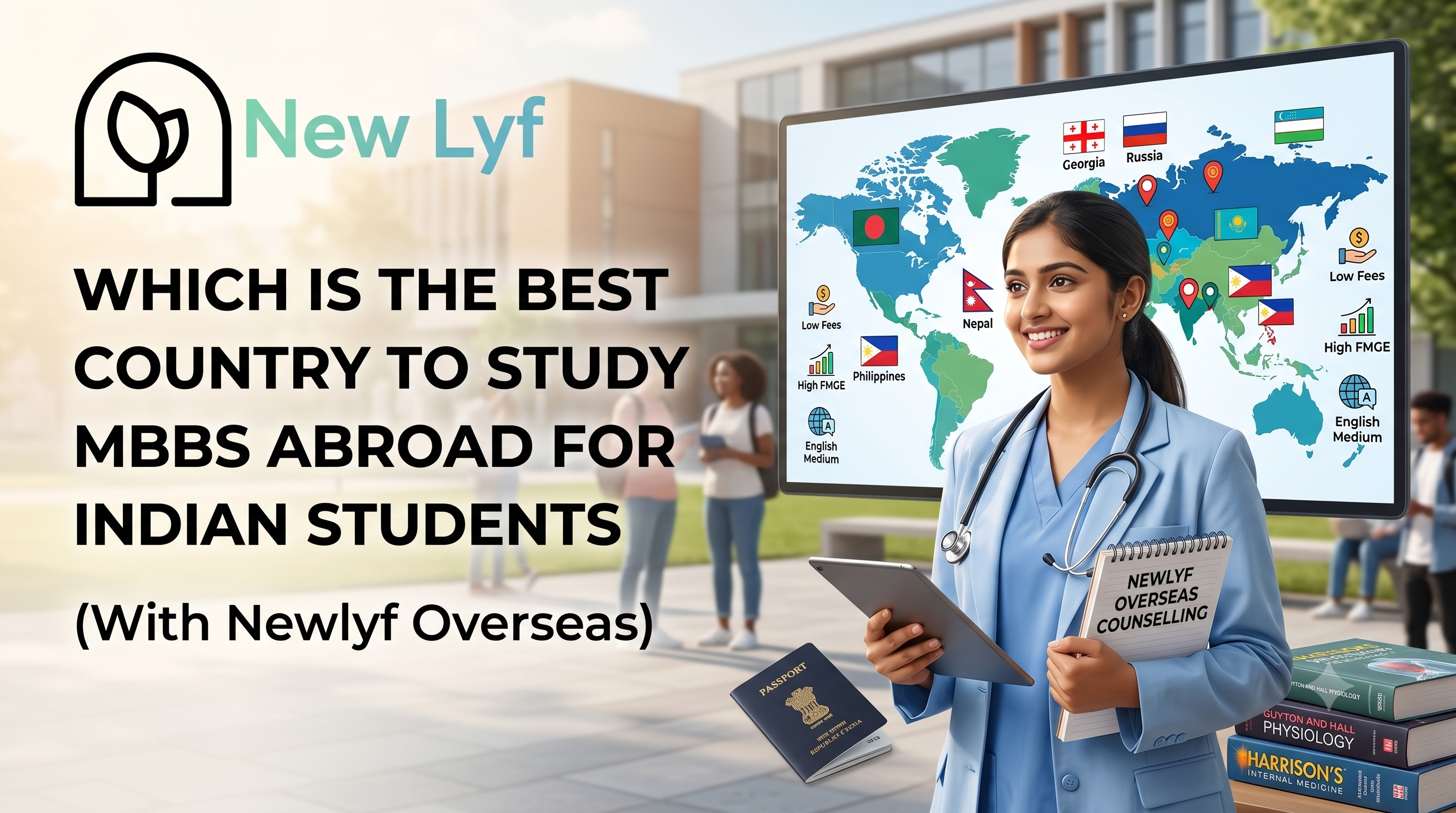
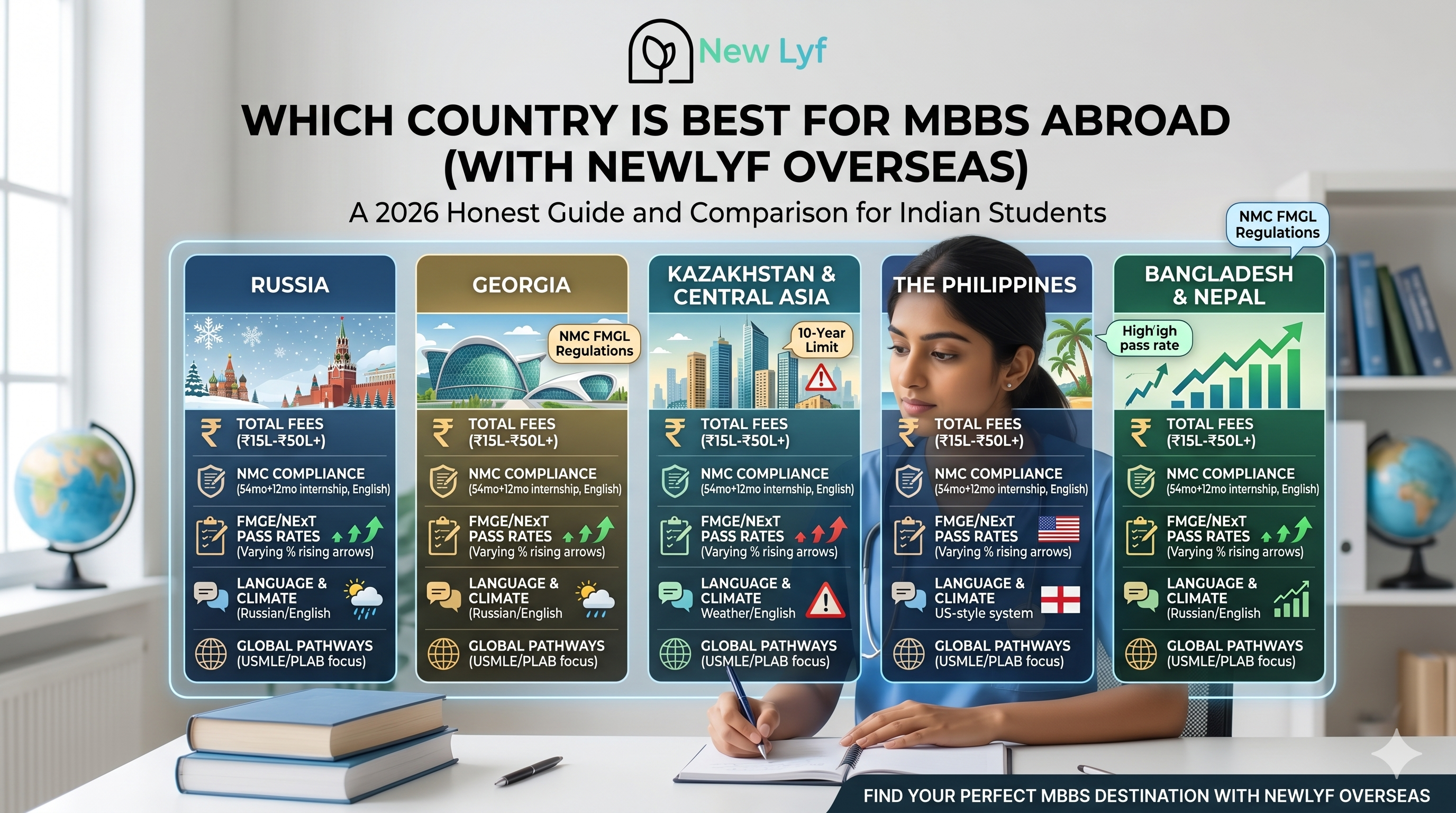
There is no single \"best\" country — the right one depends on your budget, NEET score, and how comfortable you are with the local climate and culture. Below is a working comparison; each country links to a dedicated guide with university-wise details.
| Country | Duration | Approx. Total Cost (INR) | Best For |
|---|---|---|---|
| Russia | 6 years (incl. internship) | ₹21–42 lakh | Largest number of NMC-recognised universities, strong subsidy history |
| Georgia | 6 years | ₹20–35 lakh | Modern infrastructure, fast-growing Indian student base |
| Kazakhstan | 5.5–6 years (incl. internship) | ₹20–25 lakh | Lowest all-inclusive cost among Central Asian options |
| Kyrgyzstan | 5.5–6 years (incl. internship) | ₹18–25 lakh | English medium across the board, budget-friendly |
| Uzbekistan | 5.5–6 years (incl. internship) | ₹15–20 lakh | Rising 2026 option, low living costs |
| Philippines | 4.5 years + 1-year internship (5.5 years total) | ₹20–30 lakh | US-pattern curriculum, strong for students eyeing USMLE later |
| Bangladesh | 5.8 years | ₹20–30 lakh | Cultural and climatic familiarity, short travel distance |
| Nepal | 5.5 years | ₹30–45 lakh | Closest destination, minimal adjustment for Indian students |
| China | 5 + 1 year | ₹20–26 lakh | Advanced infrastructure, competitive fee structure |
| Armenia | 6 years | ₹20–30 lakh | Growing European-recognition pathway |
Country Insights & Analysis
MBBS in Russia
Russia has the largest network of NMC-recognised medical universities of any single destination, with more than 30 institutions offering English-medium tracks — among them Kazan Federal University and Crimea Federal University, both popular with Indian applicants. Fees run from roughly ₹3.5–7 lakh per year, and several universities historically benefit from government subsidies that keep costs down further. Many Russian MBBS programmes follow a curriculum modelled on Western medical education, which makes them a reasonable fit for students who may later attempt USMLE or PLAB. Choose Russia if you want the widest possible university choice and an established, decades-long track record of Indian graduates clearing FMGE.
MBBS in Georgia
Georgia has become one of the fastest-growing MBBS destinations for Indian students in the last five years, largely on the back of modern campus infrastructure, a straightforward admission process, and a growing number of EU-recognised universities. Total costs typically sit in the ₹20–35 lakh range for the full programme. It suits students who want a European learning environment without the higher fees of Western Europe, and who value an increasingly large, well-established Indian student community on campus.
MBBS in Kazakhstan
Kazakhstan offers some of the lowest all-inclusive costs in Central Asia, with universities such as Kazakh National Medical University drawing consistent interest from Indian applicants. Tuition typically runs ₹2.5–4.5 lakh per year, with monthly living costs around ₹12,000–15,000. It's a strong fit for budget-conscious students who still want a full 5.5–6 year NMC-compliant programme with English-medium instruction and reasonable clinical exposure.
MBBS in Kyrgyzstan
Kyrgyzstan runs English-medium instruction across virtually its entire medical education system, which removes a common source of friction international students face elsewhere. Universities like Osh State University and Kyrgyz State Medical Academy are well known among Indian applicants, with total packages — tuition, hostel, and food included — often coming in under ₹25 lakh for the full course. It's a solid choice if affordability and a simple, English-only academic environment matter more to you than big-city infrastructure.
MBBS in Uzbekistan
Uzbekistan is the newest of the Central Asian destinations to gain real traction with Indian students, and 2026 has seen a noticeable rise in applications. State universities increasingly offer 100% English-medium MBBS tracks, and living costs are lower than in neighbouring Kazakhstan. If you're comparing purely on cost, Uzbekistan is currently one of the most affordable NMC-compliant options available — but because it's a newer pathway for Indian students, spend extra time verifying each university's FMGE track record before committing.
MBBS in the Philippines
The Philippines runs a US-patterned medical curriculum, which makes it a particularly strong choice for students who eventually want to attempt the USMLE and pursue residency in the United States. The programme structure (roughly 4.5 years academic + 1-year internship) aligns with NMC's minimum, and English is the primary medium of instruction nationwide — a legacy of its US-influenced education system. Expect total costs in the ₹20–30 lakh range.
MBBS in Bangladesh
Bangladesh offers Indian students a level of cultural and climatic familiarity that's hard to match elsewhere, along with a short and inexpensive journey from most parts of India. Its medical universities have hosted Indian students for decades, giving it one of the most established FMGE track records among neighbouring destinations. Total costs typically land around ₹20–30 lakh. It's a good fit for students who want the \"abroad\" advantages of lower fees and merit-based admission, without a major cultural or logistical adjustment.
MBBS in Nepal
Nepal is geographically the closest MBBS-abroad destination for most Indian students, with shared language, climate, and cultural familiarity easing the transition considerably. It tends to run higher than other options on this list — typically ₹30–45 lakh for the full course — but that's often offset by lower travel costs and an easier adjustment period, particularly for first-time international students or families who prefer proximity to home.
MBBS in China
China offers some of the most advanced medical training infrastructure on this list, with a growing number of universities running dedicated English-medium MBBS programmes for international students (roughly 5 years academic + 1-year internship). Fees are competitive, generally ₹20–26 lakh for the full course. It suits students who prioritise infrastructure and are comfortable with a more structured, less India-familiar cultural environment than Nepal or Bangladesh.
MBBS in Armenia
Armenia has quietly built a growing reputation among Indian MBBS aspirants, offering European degree recognition at a lower cost than Western Europe — typically ₹20–30 lakh for the full 6-year programme. It's a reasonable middle-ground choice for students who want a European academic environment and eventual EU-adjacent recognition pathways, without competing for the more sought-after seats in Georgia or Russia.
A quick note on Ukraine:
Ukraine was historically one of the top three destinations for Indian MBBS aspirants, but the ongoing conflict has disrupted admissions and on-campus study since 2022. If you're seeing \"MBBS in Ukraine\" content elsewhere, treat it with caution and verify current status directly before considering it.
Cost of MBBS Abroad: What's Actually Included
A country's headline fee rarely tells the whole story. When comparing costs, break the number into:
Tuition Fees
Charged annually or per semester by the university directly.
Hostel
University dorms are cheapest; private rentals cost more.
Food & Living
Ranges from ₹10k–15k/month in Central Asia; higher in Europe/Philippines.
One-Time Costs
Visa fees, flights, health insurance, police clearance, medical tests.
NExT Coaching
Worth budgeting for from year one for licensing preparation.
Total realistic budgets across NMC-compliant destinations range from about ₹15 lakh to ₹45 lakh for the entire course — still typically well under the cost of a private MBBS seat in India.
Documents Required for MBBS Abroad
Keep these ready before you start applying — incomplete documentation is the single biggest cause of delayed admissions:
Step-by-Step MBBS Abroad Admission Process
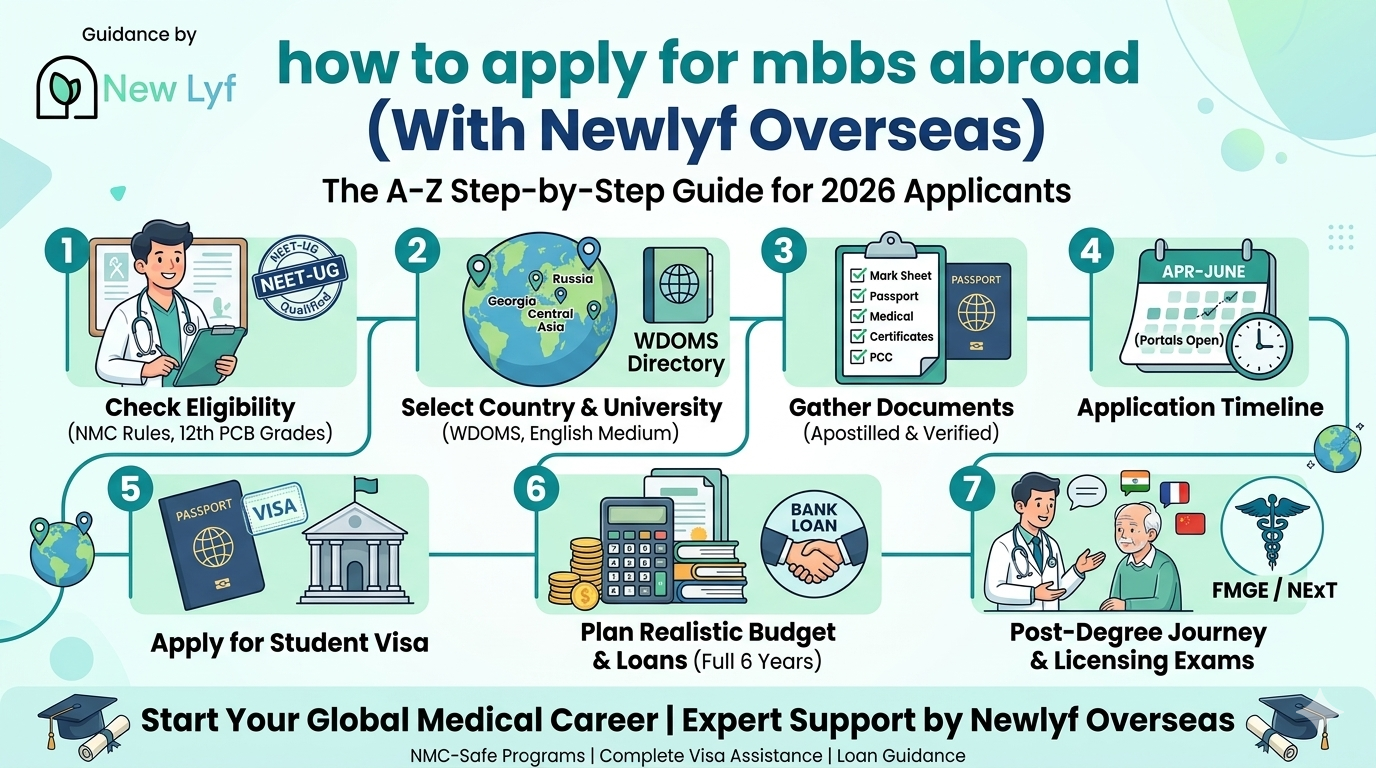
Step 1: Shortlist countries and universities
Based on your NEET-UG status, budget, and NMC/FMGL compliance (Section 4) — don't skip verification for a lower fee.
Step 2: Apply directly to the university
With your academic documents; most NMC-compliant destinations do not require a separate entrance exam beyond NEET-UG.
Step 3: Receive your offer/admission letter
And pay the initial tuition instalment as specified by the university.
Step 4: Apply for your student visa
With your offer letter, passport, and supporting documents — processing time varies by country, typically 3–6 weeks.
Step 5: Complete a pre-departure briefing
Currency, climate, hostel rules, local emergency contacts, and what to pack.
Step 6: Travel and complete on-campus registration
Including biometric/local ID formalities where required.
Step 7: Begin your 54-month academic programme
Followed by your 12-month internship at the same institution.
Step 8: Return to India and appear for FMGE/NExT
To obtain your licence to practice.
Scholarships & Education Loans for MBBS Abroad
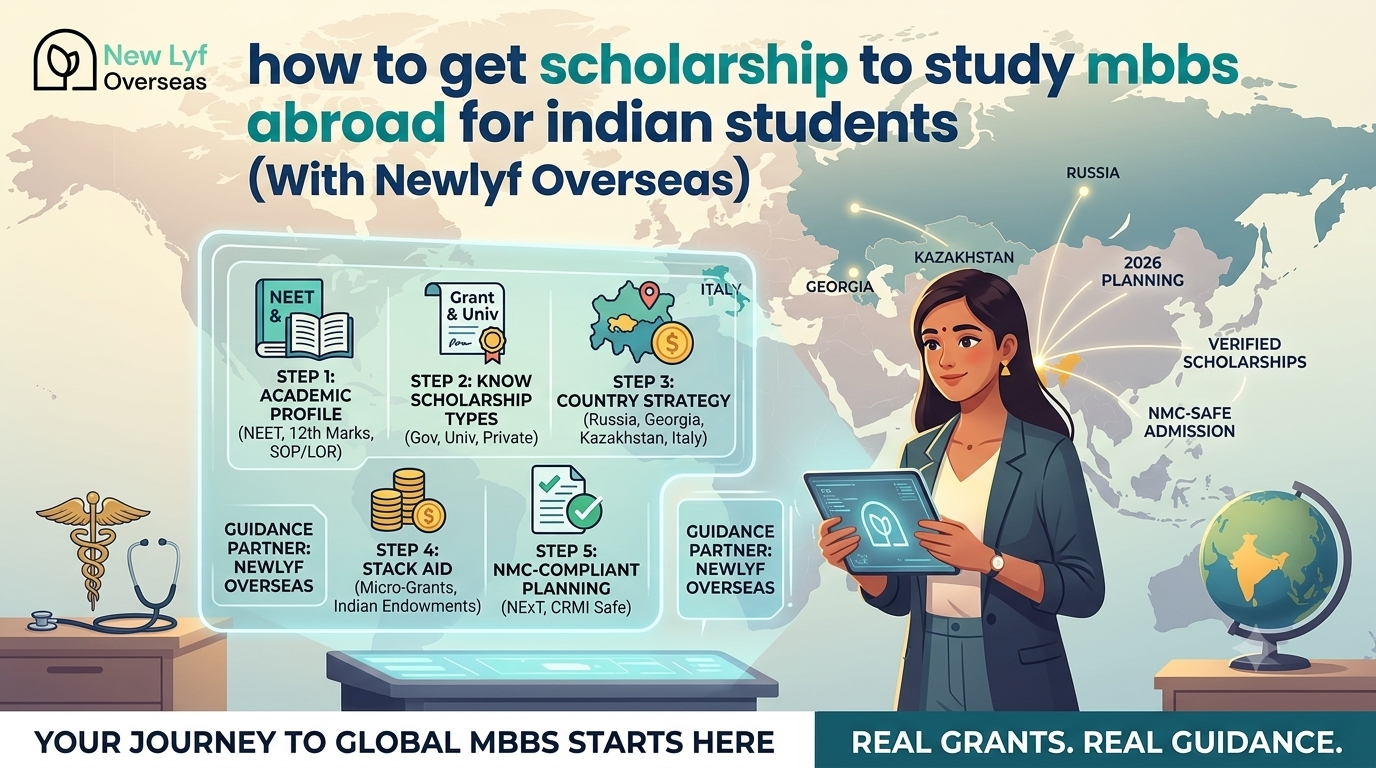
MBBS abroad is more affordable than private options in India, but it is still a significant investment. Two funding routes are commonly used:
Government and university scholarships: Some destination countries offer partial fee waivers for high-performing international students; these vary year to year and by university, so verify current offers directly rather than relying on old blog posts.
Education loans: Indian banks and NBFCs offer education loans specifically for MBBS abroad, covering tuition, living costs, and travel. Compare interest rates and moratorium periods before committing — most lenders require a co-applicant and collateral above a certain loan amount.
FMGE, NExT, USMLE, PLAB: Career Pathways After MBBS Abroad
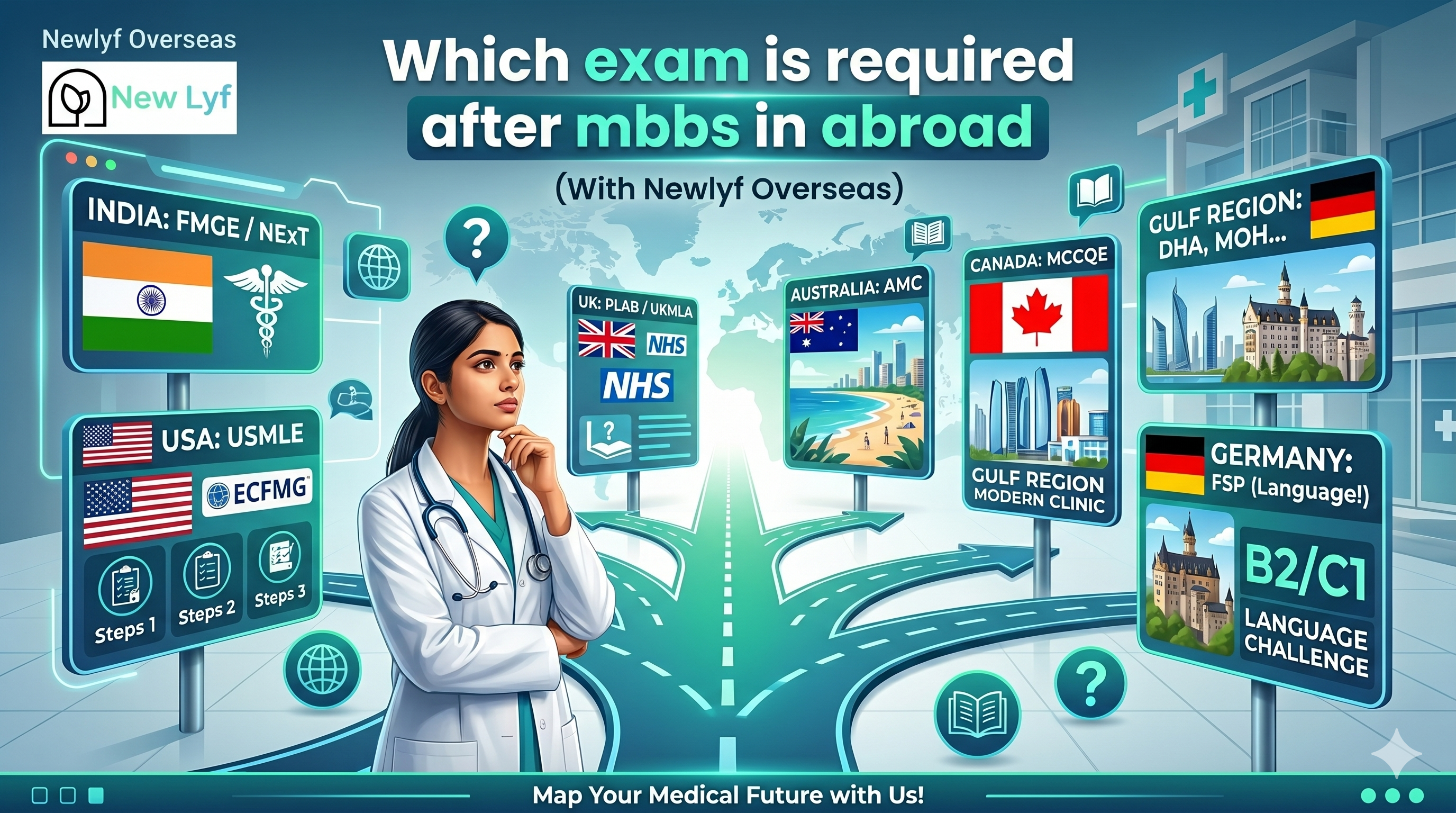
Your degree is only the first half of the journey. To practice, you need a licensing exam — and which one depends on where you plan to work:
To practice in India: You currently need to clear the FMGE (Foreign Medical Graduate Examination), conducted by the National Board of Examinations. NMC has announced that the National Exit Test (NExT) will eventually replace FMGE as a common licensing exam for both domestic and foreign graduates — as of mid-2026, FMGE remains the operative exam.
To practice internationally: Clear the USMLE for USA (the Philippines and Georgia structure their curricula to support this pathway), the PLAB exam for UK, or the AMC exam for Australia.
How to Choose the Right University Abroad
Run every shortlisted university through this checklist before paying any fee:
- ✓Is the total programme at least 54 months + 12-month internship, taught entirely in English, at the same institution? (Section 4)
- ✓Is the university listed in the WFME or FAIMER/IMED directories?
- ✓What is its FMGE/NExT pass rate for Indian graduates in the last 3 years? (Ask for verifiable data, not a marketing claim)
- ✓Is there zero donation/capitation fee, with a transparent, itemised fee structure?
- ✓Does the university offer Indian-food hostel options and an existing Indian student community?
- ✓Is the surrounding city/region considered safe, with a functioning Indian embassy or consulate nearby?
Is MBBS Abroad Safe for Indian Students?
Most established MBBS destinations for Indian students — Georgia, Kazakhstan, Kyrgyzstan, Uzbekistan, the Philippines, and Bangladesh — are considered safe, with large, well-established Indian student communities and university-run support systems.
As with any destination, avoid isolated regions, keep your local embassy's contact details on hand, and prefer universities with a track record of already hosting Indian students rather than being a \"first cohort.\"
Frequently Asked Questions
Is MBBS abroad valid in India?
Yes, provided the university complies with NMC's Foreign Medical Graduate Licentiate Regulations, 2021 — minimum 54 months of academic study plus a 12-month internship at the same institution, English-medium instruction, and the student holds a valid NEET-UG qualification. Graduates must then clear FMGE (or NExT once fully implemented) to practice in India.
Can I study MBBS abroad without NEET?
You can technically enroll without NEET, but you will not be able to register with NMC or practice medicine in India without a valid NEET-UG qualification. NEET is non-negotiable for anyone planning to return to India.
Which country is best for MBBS abroad for Indian students?
There's no single "best" — Russia and Georgia lead on infrastructure and university choice, Kazakhstan, Kyrgyzstan, and Uzbekistan lead on affordability, and the Philippines suits students eyeing USMLE later. Match the country to your NEET score, budget, and long-term practice goals rather than picking on fee alone.
What is the FMGL Regulation, 2021?
The Foreign Medical Graduate Licentiate Regulations, issued by NMC in November 2021, set binding standards — course duration, internship structure, and medium of instruction — that any foreign MBBS must meet for the degree to be valid in India.
What is the minimum MBBS duration NMC accepts for foreign degrees?
54 months (4.5 years) of academic study plus a mandatory 12-month internship at the same institution — roughly 5.5 years in total.
Will NExT replace FMGE?
Yes, eventually — NExT is designed as a single licensing exam for both Indian and foreign medical graduates. As of 2026, FMGE remains the operative exam while NExT's implementation is still being phased in; check natboard.edu.in for the latest status.
How much does MBBS abroad cost in total?
Realistically ₹15–45 lakh across the most common NMC-compliant destinations, covering tuition, hostel, and living costs for the full programme — still generally lower than a private MBBS seat in India.
What documents are required for MBBS abroad admission?
Class X and XII mark sheets, NEET-UG scorecard, valid passport, photographs, birth certificate, transfer/migration certificates, medical fitness certificate, and police clearance certificate.
Is MBBS abroad safe for Indian students?
Yes, in established destinations with existing Indian student communities and university support systems — verify safety specifics and embassy proximity per country and city before choosing a university.
Can I do my internship in India after completing MBBS abroad?
Under FMGL Regulations, your mandatory 12-month clinical internship must be completed at the same foreign institution where you studied. After returning and clearing FMGE/NExT, some additional India-based internship/registration formalities may apply — confirm current requirements with NMC directly, as this is one of the more frequently clarified areas of the regulation.
Ready to plan your MBBS abroad journey?
Get personalised guidance on university selection, NMC compliance verification, documentation, and visa process — based on your NEET score and budget.